Change Language :
What is the difference between Ethernet CAT 5e, CAT 6/CAT 6A, CAT 7 & CAT 8 cables?
Ethernet networks are available with different data transmission rates. The Ethernet cables must be adapted to the transmission rates and are divided into different cable categories, or CAT classes. Ethernet cables are structured according to categories (e.g. CAT 5, CAT 6A, CAT 7) and cover data volumes from 100MBit per second up to 10GBit per second. Only specially designed, highly flexible cables should be used for moving applications in energy chains. Normal cables used for fixed installation would not be able to withstand the extreme loads and reliable data transmission would not be guaranteed.
Our chainflex cables have been specially developed and tested for permanent moving applications in energy chains and offer the highest quality. They are equipped with a pair shield or overall shield as required. In order to select the right cable for your application, two key questions should be clarified: What mechanical requirements must the cable fulfil? and What volume of data is to be transmitted? The differences between the individual categories are explained below so that you can find the right Ethernet cable for your application.

CAT 5/CAT 5e: The most common cable*
Category 5 is the most widely used standard for network cable, although it is increasingly being superseded by higher categories. Within this category there is CAT 5e, where the "e" stands for "enhanced". CAT 5e is a further development of the original CAT 5 standard and offers significantly better electrical performance compared to it. While CAT 5 only supports speeds of up to 100MBit per second, CAT 5e enables data transmission rates of up to 1GBit per second and has a frequency of 100MHz. This is why CAT 5e is used more frequently than the older CAT 5.
- CAT 5 and CAT 5e cables are generally used for the 1000BASE-T standard.
- Hardware such as the computer itself is often the bottleneck in the system.
Our chainflex portfolio includes CAT 5 and CAT 5e cable with PVC, PUR or TPE outer jacket. Depending on your requirements, you will also find cable for small and large bend radius, e.g. with a bend factor of 15 x d or 7.5 x d.
Typical industrial applications with CAT 5/CAT 5e cables in energy chains
Machine tools: e.g. CNC machine with moving gantry
Packaging systems: e.g. highly dynamic axes with continuous movement
Robotics and automation
Automated production lines
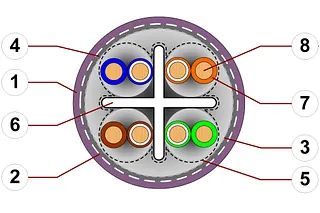
igus chainflex CAT 5e cable in cross section
1. Outer jacket: PUR mixture extruded under pressure
2. Overall banding: plastic fleece
3. Shielding foil: aluminium-laminated plastic foil
4. Overall shield: bend-resistant braiding made from
tinned copper wires
5. Banding: plastic foil
6. Separating element: bend-resistant cross filler made of TPE
7. Core insulation: mechanically high-quality TPE compound
(according to the bus specification)
8. Conductor: fine stranded wire in exceptionally bend-resistant
design made of bare copper wires
Questions about CAT 5:
The specification for Ethernet cables describes a maximum cable length of 100 metres. However, this is divided into 10m flexible cables (patch cable, e.g. between Ethernet socket and computer) and 90m cables for fixed installation (usually with solid copper cores). igus has found that chainflex cables of categories CAT 5 and CAT 5e, which have been specially developed for continuous use in energy chains, can often be used in lengths of up to 50 metres.
A CAT 5 cable is ideal for establishing an Ethernet connection at a speed of 100MBit per second. Typical industrial applications are e.g. machine tools or packaging systems.
CAT 5 cables use either two core pairs or a so-called star quad structure. In comparison, CAT 5e cables have four core pairs, which enables a higher data transmission rate.
- CAT 5: transmission rate of up to 100MBit per second
- CAT 5e: transmission rate of up to 1GBit per second
These differences make CAT 5e cables a more powerful option for higher data volumes
A CAT 5 cable can transmit a maximum of 100MBit per second at a frequency of 100MHz. CAT 5e cables are designed for a transmission rate of up to1GBit per second at a frequency of 100MHz.
CAT 6 and CAT 6A: Ideally suited for companies
Cables in the CAT 6 category are further developments of the network standard that offer higher speeds and improved performance.
- CAT 6 cables can only reliably transmit 1Gbit per second up to a length of 50 metres and have a frequency of 250MHz. However, the range can be increased with intermediate switches.
- CAT 6A is a further development of CAT 6 and enables transmission speeds of up to 10Gbit per second at a range of up to 100 metres. With a maximum frequency of 500MHz and individually shielded core pairs, reliable data transmission is guaranteed even when the cable is in motion.
Typical industrial applications with CAT 6/CAT 6a cables in energy chains
High-resolution camera systems: e.g. inline image processing in production plants
Packaging machines with high cycle rates
Highly dynamic handling systems: e.g. pick & place
Logistics systems with high data requirements: e.g. storage and retrieval units with IP cameras, control system and IO communication
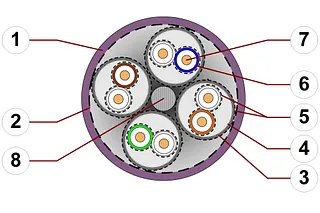
igus chainflex CAT 6A cable in cross section
1. Outer jacket: PUR mixture extruded under pressure
2. Overall banding: plastic fleece
3. Element shield: bend-resistant braiding made from
tinned copper wires
4. Element shield foil: aluminium-laminated plastic foil
5. Element banding: plastic foil
6. Core insulation: mechanically high-quality TPE compound
(according to the bus specification)
7. Conductor: fine stranded wire in exceptionally bend-resistant
design made of bare copper wires
8. Strain relief: high tensile strength centre element
Questions about CAT 6:
The specification for Ethernet cables describes a maximum cable length of 100 metres. However, this is divided into 10m flexible cables (patch cable, e.g. between Ethernet socket and computer) and 90m cables for fixed installation (usually with solid copper cores). igus has found that chainflex cables of categories CAT 6 and CAT 6A, which have been specially developed for permanent use in energy chains, can often be used in lengths of up to 70 metres. However, achieving these lengths is highly dependent on the environmental conditions and can be greatly reduced by electronic magnetic interference, e.g. mobile phone networks, frequency-controlled motors, etc.
A CAT 6 cable should always be used when establishing an Ethernet connection with a speed of 1GBit per second.
CAT 6 cables usually only have an overall shield over the four core pairs, whereas with CAT 6A cables each core pair is shielded. CAT 6A cables can also have an overall shield.
- CAT 6: transmission rate of up to 1GBit per second
- CAT 6A: transmission rate of up to 10GBit per second
These differences make CAT 6A cables a more powerful option for higher data volumes.
A CAT 6 cable can transmit a maximum speed of 1GBit per second at a frequency of 250MHz. CAT 6A cables are designed for a transmission rate of up to10GBit per second at a frequency of 500MHz.
A Cat 6 cable does not necessarily have to have an inner jacket. However, igus chainflex Ethernet cables are offered in the CFBUS and CFBUS.LB series with an inner jacket to ensure greater resistance to mechanical loads. However, the CAT 6A cables CFBUS.050 and CFBUS.LB.050 are an exception and do not have an inner jacket.
CAT 7: For the most demanding applications
CAT 7 cables allow even higher transmission rates and are even better shielded compared to the previous categories. It enables transmission rates of up to 10Gbit per second and has a frequency of 600MHz. CAT 7 cables offer excellent electromagnetic compatibility protection and are used when a very high bandwidth is required. The special feature of CAT 7 cable is the separate shielding of each individual core pair.
- All category 7 cables have four separately shielded core pairs, which in turn are additionally shielded by an overall shield. This means they are optimally protected against external interference.
- There are two standardised connector types for CAT 7 network cables.
- They are recommended for the future security of the infrastructure in new buildings.
Typical industrial applications with CAT 7 cables in energy chains
EMC-critical applications: e.g. frequency converters, welding technology
Railway technology: e.g. door systems, movable monitoring devices in trains
Robotics and automation
Assembly/pick & place systems
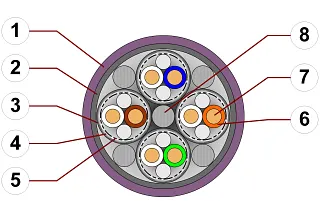
igus chainflex CAT 7 cable in cross section
1. Outer jacket: PUR compound extruded under pressure
2. Overall shield: bend-resistant braid made from
tinned copper wires
3. Element shield: bend-resistant braiding made from
tinned copper wires
4. Element shield foil: aluminium-laminated plastic foil
5. Banding: plastic foil
6. Core insulation: mechanically high-quality TPE compound
(according to the bus specification)
7. Conductor: fine stranded wire in exceptionally bend-resistant
design made of bare copper wires
8. Strain relief: high tensile strength centre element
Questions about CAT 7:
The specification for Ethernet cables describes a maximum cable length of 100 metres. However, this is divided into 10m flexible cables (patch cable, e.g. between Ethernet socket and computer) and 90m cables for fixed installation (usually with solid copper cores). igus has found that chainflex cables of category CAT 7, which have been specially developed for continuous use in energy chains, can often be used in lengths of up to 50 metres. However, achieving these lengths is highly dependent on the ambient conditions and can be greatly reduced by electronic magnetic interference, e.g. mobile phone networks, frequency-controlled motors, etc. It can also be assumed that the transmission speed is reduced as the cable length increases.
A CAT 7 cable should always be used when establishing an Ethernet connection with a speed of 10GBit per second. CAT 7 is particularly suitable for camera applications due to its high transmission speed.
A CAT 7 cable can transmit a maximum speed of 10GBit per second at a frequency of 600MHz.
Two different connectors are defined for CAT 7/7A.
- GG45 (downwards compatible with RJ-45 for office cabling)
- TERA (preferred for multimedia applications)
For safe and reliable data transmission, it is necessary for the cable to have both pair shields and an overall shield.
A CAT 7 cable is designed for operating frequencies of 600MHz and therefore always has pair shields and an overall shield. CAT 6 cables only have to be designed for operating frequencies of 250MHz and therefore often only have pair shields.
All chainflex cables can generally be designed for UV resistance. The UV resistance depends largely on the choice of outer jacket material. For outdoor use, we recommend TPE as the material for maximum resistance to UV radiation.
CAT 8: Extreme speed for data centres
Category 8 network cables have been specially designed for use in data centres, where cabling between routers and servers is usually limited to short distances. These cables are characterised by their ability to enable extremely fast data transmission without relying on fibre optic technology. With operating frequencies of up to 2000MHz and transmission rates of up to 40Gbit per second, Category 8 offers the highest standard in terms of speed and performance.
The cables are excellently shielded, making them extremely resistant to interference signals.
Category 8 is also available in two variants:
- 8.1 uses commercially available RJ45 connectors, which are compatible with most existing network infrastructures.
- 8.2, which uses special connectors, is currently still under development and offers an alternative solution for applications with the highest performance requirements.
This makes Category 8 ideal for high-performance and interference-free network connections over short distances. At igus, we do not have any Category 8 network cables in our portfolio. Our focus is on cables that are optimised for industrial applications and moving applications, such as those required in energy supply systems or dynamic environments.
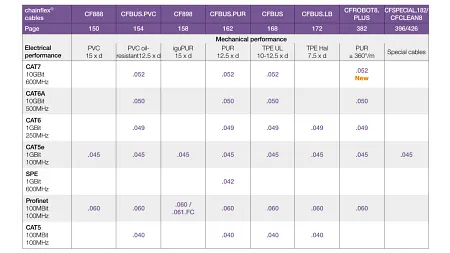
Specifications of the Ethernet cables
Conclusion
Our chainflex CAT 5e and CAT 6A cables are the perfect choice for most applications. When it comes to transmitting very large amounts of data, our CAT 7 cable are ideal as they not only offer a very high level of protection against interference signals, but are also becoming increasingly cost-efficient. Regardless of whether you need CAT 5, CAT 6 or CAT 7, we have the right solution for every data rate and every application requirement. Choose from various jacket materials: from inexpensive PVC and oil-resistant PUR to highly abrasion-resistant TPE for demanding applications. All chainflex cable are extremely reliable and come with a guarantee of up to four years as standard. Whether sold by the metre or ready for connection with connector: with our cable, we offer you the perfect Ethernet solution for every movement and every area of application.
Few people realise that the term "cable" isn't entirely correct here. Contrary to common belief, experts distinguish between wires and cables. Here we explain the difference between flexible wires and cables.
Consulting
I look forward to answering your questions

Online:
24h